Maintenance Plan For Databases in VMware environment

A quick note:

Maintaining database server in a VMware environment is crucial. In specific, taking regular backups is really important. Not only it helps in restoring database to a good state in emergency cases, but also it stops oversizing transaction log files. As there would be many transactions in a VMware environment, if you don’t pay attention to transaction log file, you will end up with a huge transaction log file (at least in MS SQL case) or your disk may become full and cause your whole environment to stop functioning. So, it is really important to have a maintenance plan in databases server (MS SQL or Oracle) appropriate for your environment.

DV portgroup is not found in the inventory after creation

Just for documentation that may help somebody else. The other day, I’ve got the following error when I intended to create an Organization VDC network in vCloud Director:

“Cannot deploy organization VDC network  (4a0c24d9-9f10-442b-8cb0-0fa9e8ccf0c8)
– com.vmware.ssdc.util.LMException: DV portgroup dvs.VCDVSNet1-a82df557-76db-4e37-9de3-53f4167db22c is not found in the inventory after creation
– DV portgroup dvs.VCDVSNet1-a82df557-76db-4e37-9de3-53f4167db22c is not found in the inventory after creation”

Normally vShield manager is the first thing I would suspect, but in this case it wasn’t the cause. I looked into many things and everything seemed normal. By the way, vCD Director is a software solution and unexpected things may happen. I thought restarting vCloud Director service is a good idea and yes, it worked! Therefore, the solution for me was running this command in vCloud Director server:

service vmware-vcd restart

Of course it may not fix the issue in your case. If it doesn’t help, look into VCD Cells page in cloud administrator console to see if there is an error message that maybe useful. Also, reconnecting vCenter is recommended.

p.s – VMware technical support told me to look into vCenter to monitor its CPU and memory usage. That’s a good point to be considered if everything else is okay and it’s not a configuration issue I believe. Also, database server may be slow not being able to return the result of a query in an acceptable time.

IP Layer Monitoring in VMware vSphere – 1

Following my last post about administration and monitoring tasks in VMware 5, I will talk about another promising feature of VMware vSphere 5.x: supporting NetFlow. NetFlow is a network protocol developed by Cisco for collecting IP traffic information. NetFlow has become an industry standard for traffic monitoring.
As I wrote earlier, cloud/network engineers would like to have the same capabilities in virtualization as they have in physical networks and nowadays NetFlow is turning out to be the new trend in producing networking devices such as switches. In the same way switches support NetFlow, VMware implemented NetFlow that can be enabled on vSwitches, specifically very useful in Distributed switches. Good to mention that from version 5.1 VMware also supports newer version of NetFlow which is IPFIX.  You can find more information about NetFlow by itself on the internet.
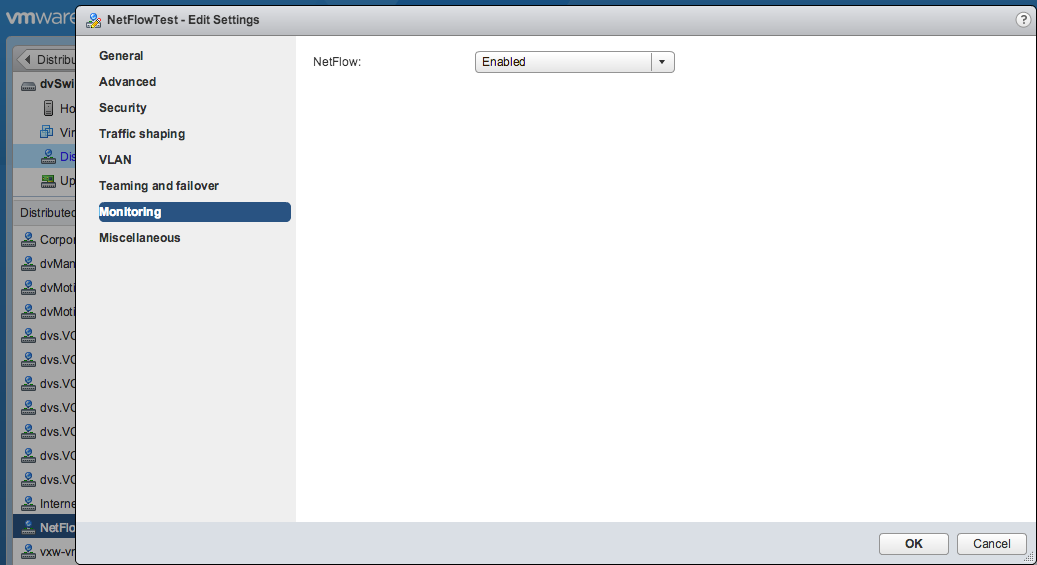
Configuring NetFlow in VMware vSphere is a 2 step process:

  1. Configure NetFlow properties on the dvSwitch.

    Hints:
    – Port is a UDP port which NetFlow collector will listen on. In NFDUMP, it is 23456! by default.
    – Of course, IP session between dvSwitch and NetFlow collector should be established in a proper way. I mean dvSwitch should see NetFlow collector.

  2. Enable NetFlow on the specific dvPort group.netflow

That’s it. In the next post, I will show how you can use a free, simple NetFlow Analyzer (nfdump, nfsen) to gather and display information about IP traffic flows in your dvSwitch.

Deploying IDS in VMware vSphere

As a network or cloud administrator in VMware environment, we would like to have the same capabilities we’ve got in a physical network. One of the most important tasks is network traffic monitoring and inspection control. Let’s say you want to install a network Intrusion Detection System (like SNORT) to monitor the traffic of a specific Virtual Data Center in vCloud environment that is translated to monitoring a specific VLAN or port group in VMware vSphere. Fortunately, VMware 5.x provides these features but apparently implementing these features is beyond VMware vCloud Director operations and it’s part of infrastructure administration tasks introduced in vSphere 5.x.
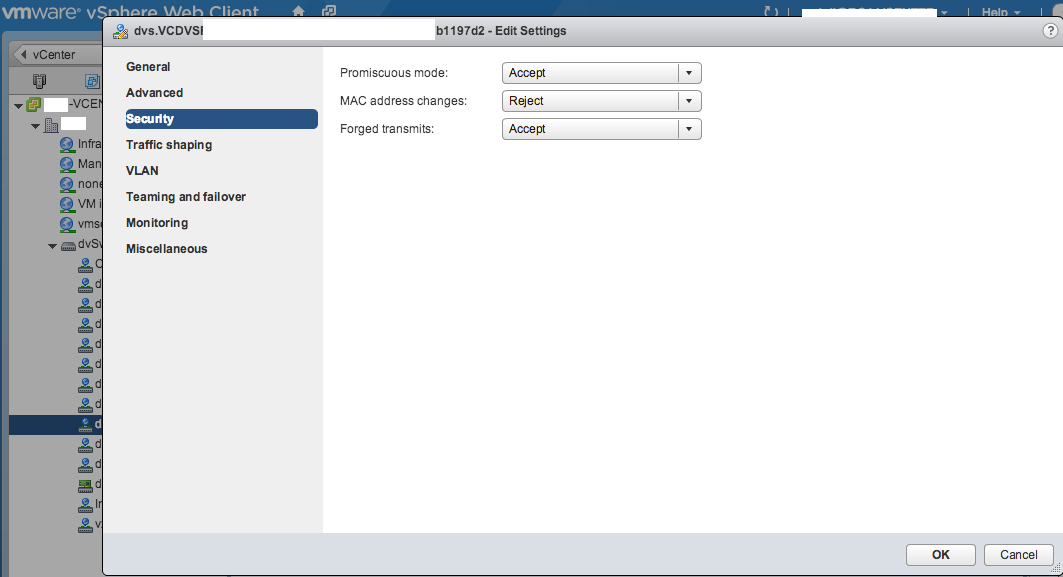
Since normally there is a port group in Distributed Virtual Switch defined by vCloud Director for each virtual data center, let’s talk about port groups in VDS. You may have noticed that when you want to create a port group in a distributed switch, you can define some security policy and one of the policies is enabling ‘Promiscuous Mode’. This is exactly equivalent to enabling promiscuous mode in a physical switch. So, as shown in the following picture, a port group can be edited to enable this mode (in vSphere Web client).

promisc

The only concern is that promiscuous mode should be defined on a port group or the whole distributed switch and not on a particular port. Doing this will cause all the traffic to be forwarded to all of the VM’s in that port group! and apparently it’s a security risk because we would like to forward the traffic to only one specific VM (port) which is our IDS. A work-around here would be to define a new port group with the same VLAN ID of the port group/VLAN we would like to monitor with the exact same configuration, then enable promiscuous mode for this newly defined port group and place the IDS VM in this port group. Because VLAN ID is the same, only IDS VM would see all the traffic. That’s an easy trick! BUT I don’t know how this trick works in some vCloud port groups that use VCDNI-backed port groups instead of VLAN-backed network pools because as I understood, VCDNI is kind of encapsulation introduced by vCloud Director and I’m not sure if a port group that is created inside vCenter can decapsulate packets. I didn’t find enough information, so I will test this out and report it in this blog.

Another approach is to use Port Mirroring feature of a VDS. Using this method it’s possible to specify source ports which need to be monitored and destination port/ports where IDS is located.

This solution is explained in detail in the following link:

vSphere 5.1 – VDS Feature Enhancements – Port Mirroring

Extra Large Edge Gateway in vCloud Director 5.5

Sometimes you feel like implementing a powerful edge gateway in your VMware vCloud environment. Let’s say you have heavy load and you plan to use load balancer capability of edge gateway in VMware vCloud Director. Unfortunately hardware configuration of vShield edge gateways are not customizable through vCloud Director and changing hardware configuration through vCenter is not possible. Also, hardware templates for use as edge gateways are limited in terms of processing power and memory. There are 3 pre-defined hardware configurations in vCloud Director 5.5: Compact, Full and Full-4. Full-4 type is a new one in vCloud 5.5 and as I know Full gateways in vCloud 5 are upgraded to Full-4 automatically when you upgrade the infrastructure to version 5.5. In brief, hardware configurations for vShield edge gateways are as follows:

  • Compact: 1 * vCPU and 256 MB of Memory – 64000 concurrent sessions
  • Full: 2 * vCPU and 1024 MB of Memory – 1,000,000 concurrent sessions
  • Full-4 (new in vCloud 5.5): 4 * vCPU and 1024 MB of Memory

I didn’t find updated detailed information for vCloud 5.5 but you can see more details about edge gateway specifications and performance parameters in vCloud Director 5.1 at this useful link.
As you see, hardware power is limited especially in regards to memory. So, in case you need a memory intensive edge gateway (Load balancer is a good example) you need to upgrade the hardware. Although there is no direct method to this through vCloud Director admin panel, the fact is that vShield Manager has this capability to implement x-large gateways. x-large edge gateway in VMware Networking and Security 5.5 has 4 * vCPU and 8GB of Memory that is quite considerable.

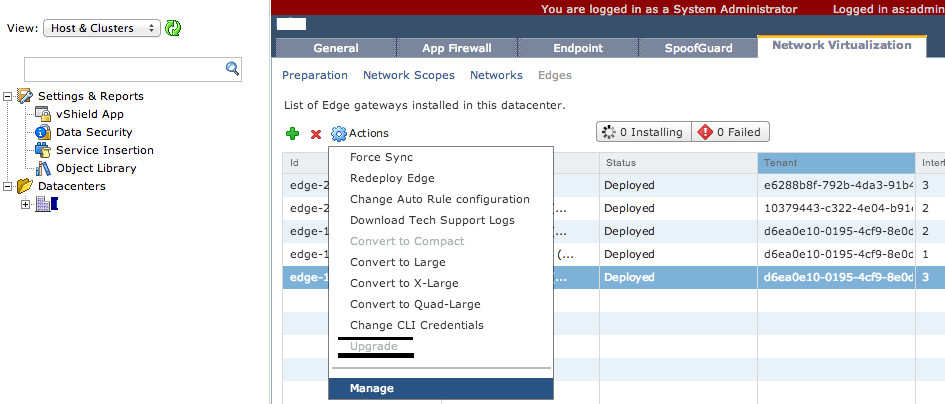
As VMware recommended, if you need to upgrade hardware configuration of an edge gateway in vCloud Director, you can use vShield portal to do so. As it’s shown in the following picture, login to vShield Manager admin panel, choose your Datacenter, on ‘Network Virtualization’ tab select ‘Edges’, click on the edge gateway you intend to upgrade and finally from Actions menu choose: ‘Convert to X-Large’. That’s all.

Just keep in mind that in the picture above login to vShield Manager is done via vCenter. So, the ‘Network Virtualization’ tab shown in the figure is within vCenter; however it’s a bit difficult to get into vShield Manager through vCenter and I faced some weird errors about Acrobot Adobe! As a result, I recommend to use vShield Manager directly to avoid such issues.
Sticky sessions in vShield Edge Gateway Load Balancer

One of the features of edge gateways in VMware vCloud Director is the capability of implementing load balancer for HTTP, HTTPS and TCP-based applications in a virtual data center. For web applications (in specific HTTP), session management is an important matter. If web developers don’t implement session management in application level (using database, … to store sessions) and rely on Cookies, load balancer could be an issue. In these cases, network administrators are asked to configure load balancer with sticky session. Simply it means that if a client is forwarded to a web server for the first time (especially login page), it should stick to that specific server in later web requests. If it doesn’t happen, user may be forced to login again that would be frustrating!

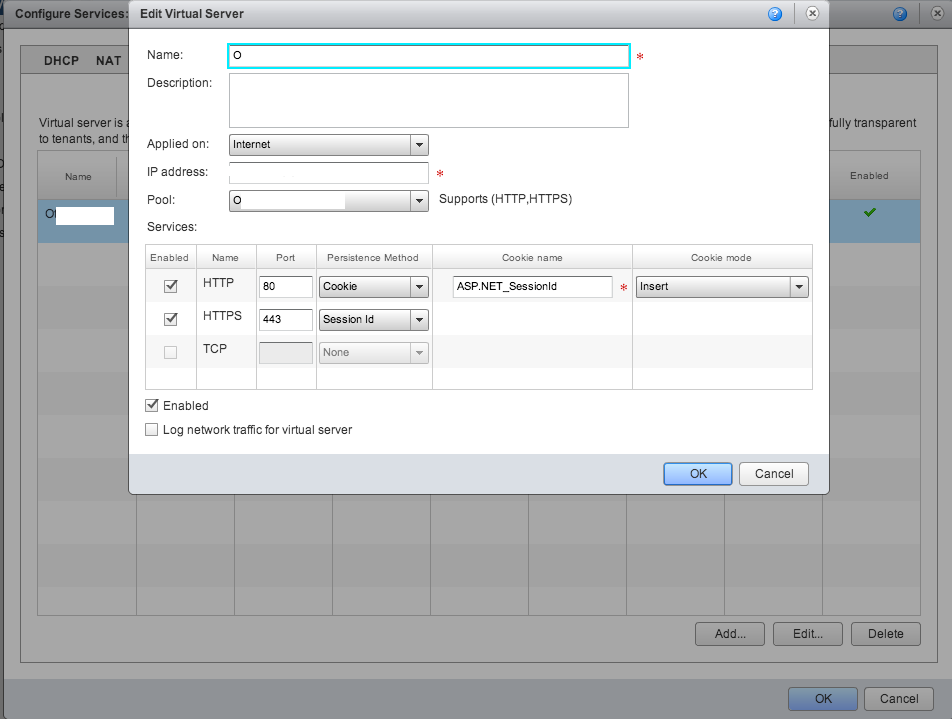
By the way, when it comes to configuring vShield Edge Gateway to do load balancing, there is no obvious option to choose Sticky Session but it’s possible to do this by specifying proper value for Cookie name in the Virtual Server. As it’s shown in the picture, the procedure is as follows. I assume that you already know how to implement Load Balancer by creating Pool Servers and Virtual Server. See this link fore more information on how to create Load Balancer.


lb_vcns

  1. Right Click on the Edge Gateway and choose ‘Configure Services’
  2. Select ‘Load Balancer’ tab
  3. Go to ‘Virtual Servers’ section
  4. Edit selected Virtual Server
  5. Choose ‘Cookie’ as Persistence Method instead of default ‘None’
  6. Type proper value as Cookie Name; i.e, ‘ASP.NET_SessionId’ for .NET application, ‘PHPSESSID’ for PHP, … (ask your developer)

Upgrade VMware vCloud Networking and Security to 5.5

When you want to upgrade VMware vCloud Director 5.1 to version 5.5, VMware vCloud Networking and Security should be upgraded to 5.5 as well because vCloud Director 5.5 is not backward compatible with vShield 5.1. Unfortunately and surprisingly, the documentation on VMware website to do so is not accurate! and it took some time for me to realize what’s the correct procedure. So, I thought it would be useful to share it here for those who can’t find the things mentioned in VMware website to upgrade VMware vCloud till they modify the documentation.

Actually, the part which is not accurate is where it explains the steps to upgrade vShield Edge appliances and it is a crucial part because failing to do this will result in failure in managing Edge gateways through vCloud Director interface. Since there would be one vShield Edge system appliance for each Edge Gateway that is created in Virtual Data Centers, you will have considerable number of vShield Edges in your environment and you should take care of them one by one. By the way, after upgrading vShield Manager to 5.5 is done (it’s easy, just uploading the upgrade bundle in vShield web console and reboot), the most important one is Upgrading vShield Edge.

Let’s look at the document on VMware website: Best practices for upgrading to VMware vCloud Networking and Security 5.5 , it says:

If you have vShield Edge 5.1.0 or later instances, upgrade each Edge:

  1. Log in to the vSphere Client.
  2. Click the data center for which vShield Edge instances are to be upgraded.
  3. Click the Network Visualization tab. All existing vShield Edge instances are shown in the listings page. An arrow icon is shown for each vShield Edge that must be updated.
  4. Click an Edge and click Upgrade from Actions to start the upgrade. When the Edge is upgraded, the arrow icon no longer appears.
  5. Repeat for each vShield that must be upgraded

After logging in to vSphere client, you will notice that there is no “Network Visualization” tab, but instead “Network Virtualization” tab. It must be a typo but even after clicking on “Network Virtualization” you will face some errors complaining about not having Acrobot Adobe Reader and so on! While the proper way to do this is to Log in to vShield Manager Web console (not vSphere Client) and look for Network Virtualization (instead of Visualization) under your DataCenter and the rest of steps are the same. You need to choose each Edge, select “Actions” on the top and choose “Upgrade” which will result in an automatic upgrade of that special Edge Gateway to new version.

vshield5.5

I hope they modify their document because it is considered as the most reliable one.


Migrate a VM by changing Datastore in vCloud Director

Migrating and relocating VMs is a great feature in Virtualized environments. You can do migration and perform your maintenance without disrupting any service. Migration in VMware is easy by utilizing vMotion in vCenter. You right click on VM, then choose Migrate and follow the instructions. But how we can relocate (change datastore or storage vMotion) a VM in vCloud Director?
Actually I was expecting the procedure in vCloud Director to be similar to vCenter, but when I right-clicked on the VM, I couldn’t find a ‘Migrate’ option or something like that. And apparently it’s not a good practice to migrate a VM which is controlled by vCloud Director through vCenter. But fortunately storage vMotion is possible in vCloud Director if you have separate Storage Profiles. To do this kind of relocation, right-click on the VM, then choose ‘Properties’; in ‘General’ tab you will find a pulldown menu for changing Storage Profile. Simply change Storage Profile to the desired one and bingo! Storage will be changed. You can even see the progress of relocation in vCenter.

Some tips:

  • As mentioned, changing datastore is possible if proper storage profiles are defined in the environment. That being said, it’s not possible to relocate to an individual, specific datastore. Actually, storage profile is another abstract layer over storage infrastructure that is being used by vCloud Director. To be honest, I didn’t have deeply realized what’s the main purpose of introducing storage profile and storage capability yet and why it doesn’t use datastore cluster instead. By the way, keep in mind that you need to create separate storage profiles if you have separate storages and you want more flexibility in vCloud. To get more information, look at this link: Using Storage Profiles with vCloud Director.
  • I couldn’t find much resources on the effects of migrating a VM from one host to another in vCloud Director environment; it is possible to perform this in vCenter and I did it in some cases with no issues. I suppose vCloud Director is working on higher level and will be notified of the changes.

2TB Datastore or Bigger?

I’ve got some design considerations about creating Volumes in storage which supposed to be used by virtualization infrastructure (VMware 5.1) as datastore; I ended up reading this great article by Michael Webster which saved my day and I would like to share:
The Case for Larger Than 2TB Virtual Disks and The Gotcha with VMFS
Overall, it seems that VMware vSphere 5.5 has good advantages and improvements over 5.1.

NAT and PAT in vCloud Director 5.1

In VMware vCloud Director 5.1, NAT (Network Address Translation) and PAT (Port Address Translation) can be implemented using Edge Gateway of a vDC. Edge Gateway is created by Networking and Security component if you want a routed network in your Virtual Data Center.

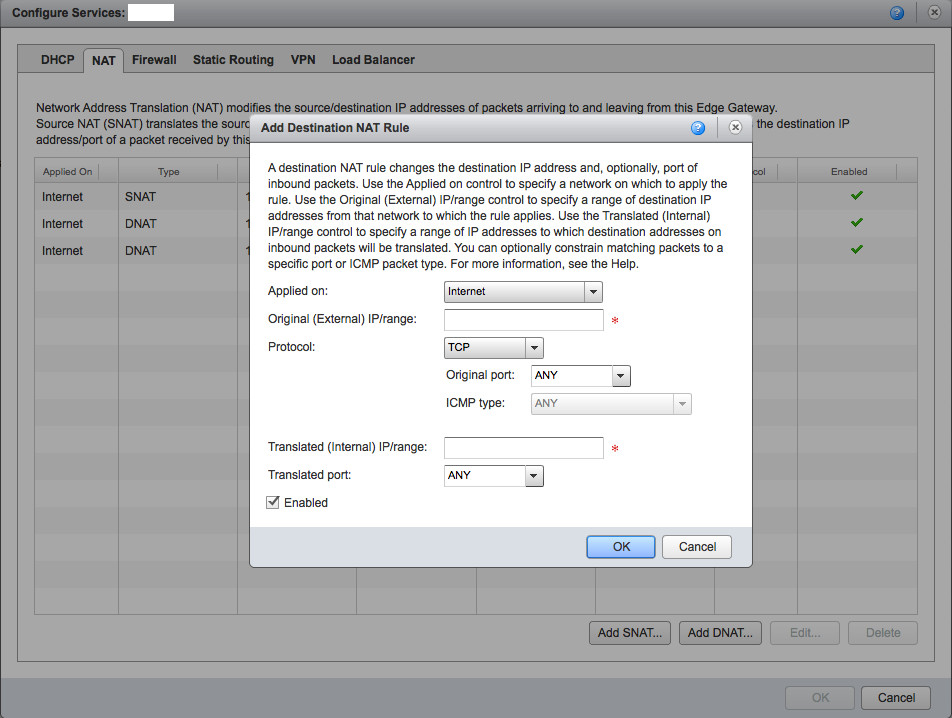
Both NAT and PAT rules can be added/configured in Edge Network Services under NAT tab. There you can define Source NAT/PAT (SNAT) or Destination NAT/PAT (DNAT) rules. Apparently, SNAT provides connectivity to external network for your internal network users/machines and DNAT provides access to your internal network (the whole network or a specific machine or a specified port) from an external network.

NAT

The interesting point is that as it shown in the figure, in both cases, either SNAT or DNAT you have to choose your external network (‘Internet’ in this example) as the ‘Applied on’ network.

The other important thing is that you need to have a Firewall rule for NAT/PAT rules. For example if you are PAT’ing port 80 of an external IP to port 80 of an internal IP (DNAT), there must be a rule in Firewall that allows access to port 80 of external IP. In fact, in this case it is firewall that acts first; after firewall allows the connection, translation (DNAT) would be done.